A researcher at a neighboring institution reviewed a Celleste prediction for a collagen-hydroxyapatite formulation and said it was off in a consistent direction. They then explained the pattern using results from their own experiments. That exchange is part of what working at 8 HaMada Street, Weizmann Science Park, Rehovot can mean in practice: useful scrutiny is close enough to enter the work before assumptions harden.
Weizmann Science Park overview
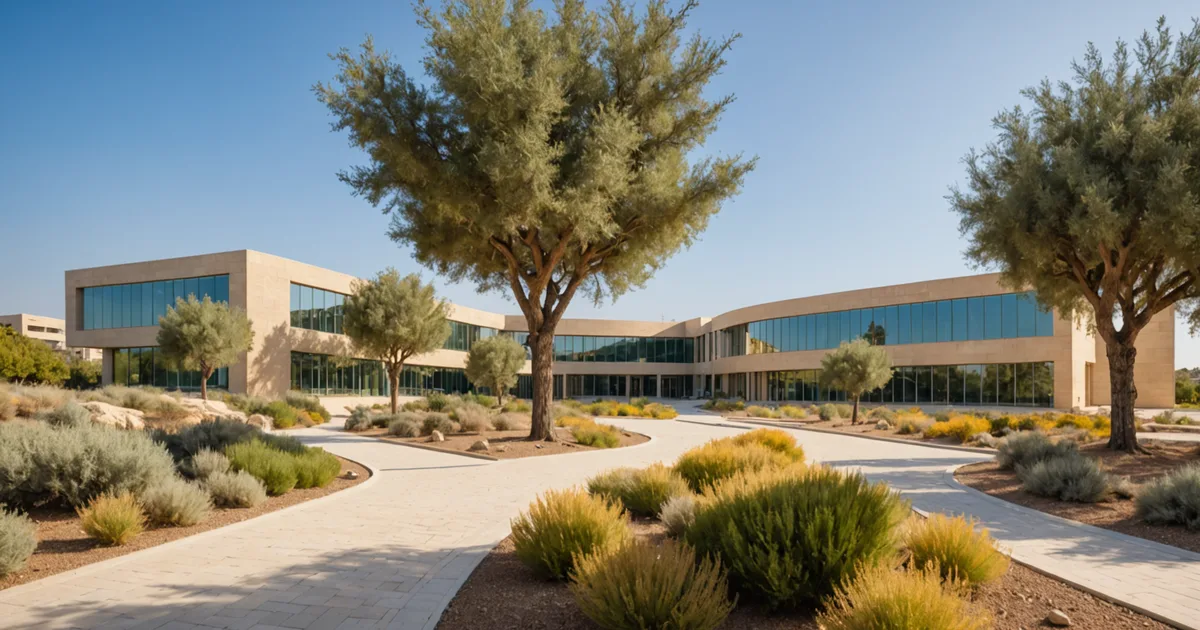
Celleste is based at 8 HaMada Street, Weizmann Science Park, Rehovot, about 25 kilometers south of Tel Aviv. The address places us beside a concentrated research environment, not inside the Weizmann Institute of Science itself.
The Weizmann Institute is one of Israel's major research universities, with strength in chemistry, biology, and materials science. The Science Park sits adjacent to its campus, but it is not formally part of the university. That distinction matters when describing where we work and what access we do, or do not, have.
The companies around us work across diagnostics, drug delivery, agricultural technology, and food science. Those fields overlap with the questions behind Celleste's platform for bio-material formulation prediction, while keeping our company separate from the university's research activities.
Research proximity in validation work
Proximity changes the rhythm of validation. A question about a formulation can meet someone familiar with the underlying material, the measurement problem, or the limits of a published result without waiting for a formal conference or a new collaboration.
The collagen-hydroxyapatite example made that concrete. The neighboring researcher did not merely say that the prediction missed. They pointed out that it missed in a consistent direction and connected that pattern to their own experimental observations. That feedback gave us a more useful calibration question than a single pass or fail result would have done.
It also set a boundary. Nearby expertise can expose a blind spot, but it does not make every result representative, and it does not replace controlled validation by the teams who generate the measurements.
Calibration through Israeli bio-materials research
Our calibration work draws on published literature and on careful conversations about how experiments were run and interpreted. Within the Weizmann Institute, relevant context can come from the Faculty of Chemistry, including the Materials and Interfaces department, the Faculty of Biochemistry and Molecular Biology, and the Plant and Environmental Sciences division.
We also work in a wider Israeli academic setting that includes active bio-materials groups at the Hebrew University of Jerusalem, the Technion, Bar-Ilan University, and Tel Aviv University. These communities provide different material systems, methods, and ways of framing a result. They also make clear why a prediction should be tested against evidence rather than accepted because it sounds chemically plausible.
We are not claiming special access or partnerships that we do not have. Celleste's training data uses published literature, and we cannot use proprietary experimental data without explicit agreement from its owner.
Working at the research frontier: requirements
Working near active research means being precise about what is known, what has been inferred, and what remains uncertain. The Celleste platform can help predict bio-material formulations, but its output still depends on the quality, scope, and comparability of the evidence available to it.
That makes calibration a continuing task rather than a launch milestone. We compare predictions with reported results, investigate systematic errors, and ask whether a disagreement reflects the formulation, the measurement method, or a gap in the published record. Conversations with researchers can sharpen those questions, but they do not turn limited evidence into certainty.
The location is useful because it keeps material behavior connected to real experimental practice. It is also a reminder that a research frontier contains disagreement, incomplete data, and results that do not transfer neatly from one laboratory to another.
Bootstrapping and formulation tool choices
Celleste is self-funded, or bootstrapped. That means we are not working backward from investor timelines when deciding which validation question deserves attention or when a product claim is ready to make.
It also means resources are limited. We have to choose carefully between expanding the platform, improving calibration, and spending time with researchers who can challenge an assumption. Progress is measured by whether the work becomes more dependable and more useful, not simply by how quickly a milestone can be announced.
Being based in the Weizmann Science Park does not remove those constraints. It gives us a nearby research district where claims can be questioned by people who understand the experiments behind them. That keeps us honest about what the platform can and cannot do.